Jump Rope vs Running: Which Cardio Workout Is Right for You?
When it comes to simple, effective cardio, few exercises get compared as often as jump rope and running. Both have been around for decades, both require minimal gear, and both can torch calories and seriously improve your fitness. But they’re not the same workout — and depending on your goals, one might serve you significantly better than the other.
In this guide, we break down jump rope vs running across the factors that matter most: calorie burn, cardiovascular benefits, muscle engagement, joint impact, and overall convenience. By the end, you’ll have a clear picture of which workout belongs in your routine.

What Jump Rope and Running Are
Jump rope is a high-intensity, rhythmic exercise that engages your entire body. Whether you’re doing basic two-foot jumps or advanced double-unders, the movement demands constant coordination between your hands, feet, and core. It’s used by elite boxers, CrossFit athletes, and weekend warriors alike — and it scales easily from beginner to advanced.
Running is one of the most natural forms of human movement. From a light jog to an all-out sprint, running is a classic aerobic exercise that builds endurance, burns fat, and strengthens the lower body. Like jump rope, it works for all fitness levels — beginners can start with a walk-run interval approach, while seasoned athletes can tackle half-marathons and beyond.
Both exercises are accessible, effective, and require no gym membership. The real differences emerge when you look at the details.
Calories Burned and Weight Loss
Calorie burn is one of the first things people compare when choosing a cardio workout — and both jump rope and running deliver impressive results.
- Jump rope burns roughly 600–1,000+ calories per hour depending on intensity and body weight. At a vigorous pace, it can burn upward of 10–15 calories per minute, making it one of the most calorie-dense exercises available.
- Running burns approximately 400–800 calories per hour, again depending on pace, terrain, and body weight. A 160-pound person running at a 6 mph pace burns around 600 calories per hour.
Jump rope often wins on time efficiency — you can achieve a high-calorie burn in a shorter session. A focused 20-minute jump rope workout can match the calorie output of a 30–40 minute run. That said, running is generally easier to sustain for longer periods, which can lead to greater total calorie expenditure over time.
For weight loss, both exercises are effective when combined with a healthy diet. The best choice is whichever one you’ll stick with consistently.
Cardiovascular Benefits
Both jump rope and running are excellent for your heart and lungs — but they challenge the cardiovascular system in slightly different ways.
Jump rope raises your heart rate rapidly, often within the first minute of jumping. This makes it particularly effective for high-intensity interval training (HIIT), where short bursts of max effort are alternated with brief rest periods. This style of training has been shown to improve VO2 max, boost cardiovascular efficiency, and enhance heart health in a compressed timeframe.
Running builds cardiovascular endurance through sustained aerobic effort. Longer runs train your heart to pump blood efficiently over extended periods, improving aerobic capacity and lung function. Distance running is especially effective at developing the aerobic base that supports overall fitness and longevity.
Bottom line: Jump rope excels at rapidly elevating heart rate and supporting interval-based cardio. Running is superior for building long-term aerobic endurance.
Muscle Groups Worked
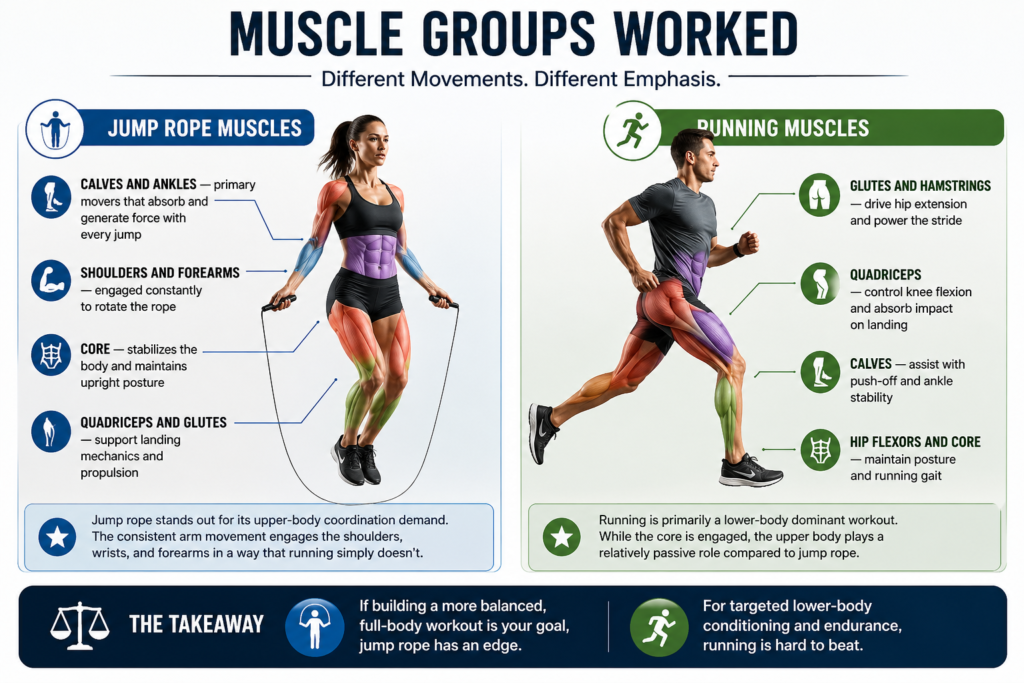
These two exercises don’t just differ in how they feel — they also target different areas of the body.
Jump Rope Muscles
- Calves and ankles — primary movers that absorb and generate force with every jump
- Shoulders and forearms — engaged constantly to rotate the rope
- Core — stabilizes the body and maintains upright posture
- Quadriceps and glutes — support landing mechanics and propulsion
Jump rope stands out for its upper-body coordination demand. The consistent arm movement engages the shoulders, wrists, and forearms in a way that running simply doesn’t.
Running Muscles
- Glutes and hamstrings — drive hip extension and power the stride
- Quadriceps — control knee flexion and absorb impact on landing
- Calves — assist with push-off and ankle stability
- Hip flexors and core — maintain posture and running gait
Running is primarily a lower-body dominant workout. While the core is engaged, the upper body plays a relatively passive role compared to jump rope.
If building a more balanced, full-body workout is your goal, jump rope has an edge. For targeted lower-body conditioning and endurance, running is hard to beat.
Joint Impact and Injury Risk
Both exercises involve repetitive impact — and both carry injury risk if you’re not careful.
Running is a higher-impact activity in terms of cumulative joint stress. Each running stride generates a ground reaction force of roughly 1.5–3x your body weight. Over miles and miles of training, this repeated loading can contribute to knee pain, shin splints, stress fractures, and hip issues — especially if you ramp up mileage too quickly or run in worn-out shoes.
Jump rope also creates joint stress, particularly in the ankles, knees, and lower back. However, because jumps are smaller and more controlled, the impact per repetition is generally lower than a full running stride. That said, jumping on hard surfaces with poor form — or without adequate footwear — can still lead to overuse injuries.
Tips to reduce injury risk for both:
- Start gradually and build intensity over time
- Prioritize proper form over speed or duration
- Jump rope on wood floors, rubber mats, or grass rather than concrete
- Run in well-cushioned, properly fitted shoes
- Incorporate rest days and cross-training
People recovering from knee or hip injuries may find jump rope more manageable, though both activities should be cleared with a healthcare provider after injury.
Convenience, Cost, and Equipment
One of the best things about both jump rope and running is how little they cost.
Jump rope:
- A quality jump rope costs $10–$40
- Requires only a small, flat space — indoors or outdoors
- Can be done in any weather
- Easy to pack for travel
- No gym, track, or trail needed
Running:
- Costs little beyond a good pair of running shoes ($80–$150)
- Requires outdoor space or a treadmill
- Weather-dependent if running outside
- May require finding safe, suitable routes
- Excellent for those who enjoy being outdoors
For people with limited space or unpredictable schedules, jump rope is hard to beat. A 20-minute jump rope session in your living room can be done before work, during lunch, or after the kids go to bed. Running, while still accessible, depends more on conditions outside your control.
Which One Is Better for Different Goals?

There’s no universal winner — the right choice depends on what you’re trying to accomplish.
Choose Jump Rope If You Want To:
- Burn calories quickly in a short time window
- Improve agility, coordination, and footwork
- Work out indoors without equipment or a gym
- Add variety to a current cardio routine
- Train like a boxer or improve athletic performance
Choose Running If You Want To:
- Build long-distance aerobic endurance
- Train for races like 5Ks, half-marathons, or marathons
- Enjoy outdoor exercise and time in nature
- Sustain cardio for extended periods at a moderate pace
- Follow a straightforward, structured training plan
Use Both If You Want To:
Many athletes and fitness enthusiasts combine jump rope and running throughout the week. Jump rope sessions can serve as high-intensity conditioning days, while running fills in steady-state aerobic work. Together, they cover nearly every aspect of cardiovascular fitness.
The Final Verdict: Jump Rope vs Running
Jump rope and running are both exceptional cardio workouts — and the debate between them doesn’t need to have a single winner. Jump rope edges ahead on time efficiency, full-body engagement, and convenience. Running leads the way in aerobic endurance, distance training, and sustained calorie burn.
The real key is matching your workout to your goals. If you’re short on time and want an intense, full-body burn, grab a rope. If you’re chasing a half-marathon PR or simply love getting outside, lace up your shoes.
Better yet, try both. Your heart doesn’t care which one you choose — it just wants you to move.